
SLS 3D Printing Service in Ukraine
Selective laser sintering (SLS) builds functional plastic parts by fusing nylon powder with a laser, layer by layer. Because the surrounding loose powder supports each layer, SLS needs no support structures and prints complex geometry, lattices and captive assemblies in a single build. Parts are near-isotropic and durable. We run SLS in-house in Kyiv on Formlabs Fuse hardware — send an STL and we quote.
Explore
We have produced parts since 2015 (12,000+ orders) and operate FDM, SLA, SLS and MJP plus 3D scanning under one roof. This page is the engineering reference for our SLS service: what the process is good at, the nylon material line-up, where it beats FDM and resin, what it costs, and how to order. It is written by the people who pull the parts out of the powder cake, not by a sales desk.
What is SLS 3D printing, and why does “no supports” matter?
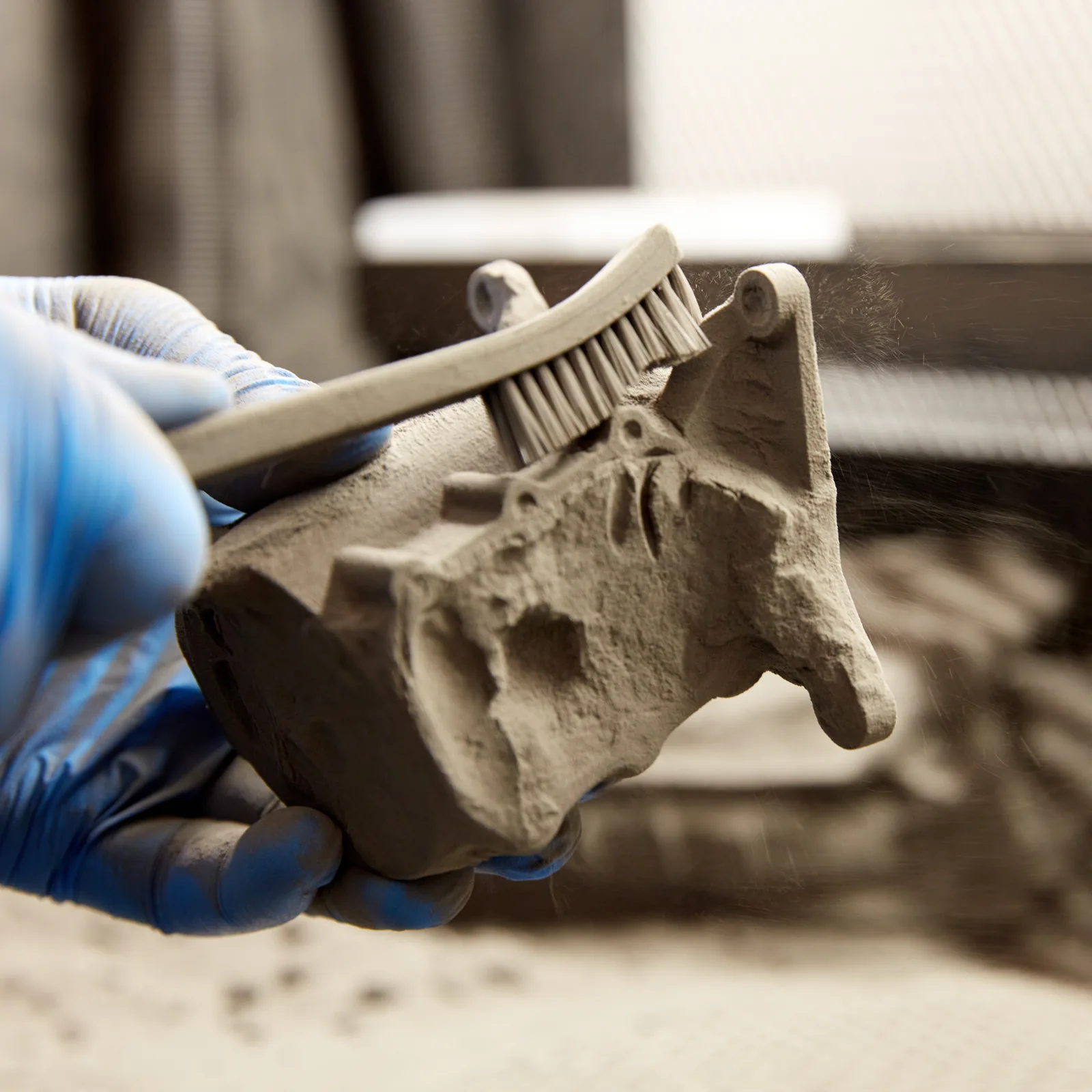
In SLS, a thin layer of polymer powder is spread across a heated build chamber, and a laser traces and fuses the cross-section of each part. The platform drops one layer thickness, fresh powder is recoated, and the process repeats. Un-fused powder stays in place and physically holds up every overhang, bridge and internal feature — so the part comes out of a solid “cake” of powder with no support structures to design around, snap off, or sand away.
That single fact drives most of the engineering advantages:
- Complex geometry is free. Internal channels, conformal cooling ducts, thin ribs, organic topology-optimized shapes and deep undercuts print with no penalty — there is nothing to support.
- Assemblies in one build. Captive hinges, ball joints, chain links and enclosed lattices come out already assembled and moving; you just remove the trapped powder.
- Dense nesting. Parts float anywhere in the chamber volume in X, Y and Z, so a build can be packed full of mixed parts — this is what makes SLS economical for batches.
- No witness marks. No support scars means a uniform matte surface over the whole part, all the way around.
The other half of the story is the material. SLS nylon is near-isotropic — it has roughly the same strength in every direction — because the laser fully melts and re-solidifies the polymer rather than welding extruded threads together. That is the property that lets you treat an SLS part as a real engineering component, not a fragile prototype.
Which materials do you print in SLS?
The workhorse is nylon (polyamide) powder. We choose the grade on the part’s mechanical job, not on what we’d like to sell you. Figures below are typical for laser-sintered powders; the exact datasheet value depends on the specific powder lot and post-processing.
| Material | Tensile strength | Character | Best for |
|---|---|---|---|
| Nylon PA12 | ~48–50 MPa, ~11% elongation | All-round, near-isotropic, matte; biocompatible grades exist | Housings, ducts, brackets, jigs, end-use parts |
| Nylon PA11 | Lower stiffness, higher elongation | Tougher and more ductile than PA12; survives repeated flexing | Living hinges, clips, snap-fits, impact parts |
| PA-CF / Nylon 11 CF | ~69 MPa | Carbon-fiber filled — stiff, heat-resistant, lightweight; abrasive to handle | Structural brackets, load-bearing and thermally loaded parts |
| TPU 90A | Flexible (Shore 90A) | Rubber-like elastomer with energy return; complex flexible geometry | Gaskets, seals, bumpers, padding, lattice cushions |
Two material pages go deeper on the most common requests: full mechanical data and design guidance for SLS Nylon PA12, and the stiff, heat-resistant carbon-filled PA-CF / Nylon 11 CF. If you are not sure which grade fits, describe the load case and operating temperature in your enquiry and we will recommend one.
What is SLS used for?
SLS sits in the sweet spot between prototyping and injection molding: functional parts, in real engineering plastic, in quantities from one to a few thousand, without tooling. Typical work that comes through our shop:
- Enclosures and housings — electronics cases, instrument bodies, connector shells with integrated bosses and snap features.
- Ducting and manifolds — air and fluid channels with smooth internal paths that would need supports in FDM or resin.
- Brackets and mounts — load-bearing structural parts, especially in PA-CF where stiffness and heat resistance matter.
- Living hinges and flexures — PA11 parts that bend repeatedly without cracking.
- End-use and spare parts — out-of-production components, custom fixtures, jigs and assembly aids.
- Small-batch production — 10 to 1,000+ identical parts nested into builds, where injection-mold tooling can’t be justified.
One field where the no-supports, near-isotropic combination earns its keep is unmanned systems — lightweight, durable nylon parts that take vibration and field abuse. We cover that use case separately in SLS for defense and UAV parts.
SLS vs FDM vs SLA — which should you choose?
These three technologies solve different problems. The honest short version: FDM is cheapest and largest for simple, one-off or iterative parts; SLA/resin wins on fine detail and smooth surfaces for visual, dental, jewelry and casting work; SLS wins when you need functional, durable, geometrically complex parts or a small batch.
| SLS (nylon) | FDM (filament) | SLA / resin | |
|---|---|---|---|
| Supports | None — powder supports | Required | Required |
| Strength | Near-isotropic, durable | Anisotropic — Z layer adhesion ~50–70% of XY | More brittle, UV-sensitive |
| Surface | Uniform matte | Visible layer lines | Very smooth, fine detail |
| Best at | Functional parts, complex geometry, small batches | Cheap, large, simple, iterative | Detail, visual, dental/jewelry/casting |
| Batch economics | Strong — dense nesting | Weak — one part per nozzle-hour | Moderate |
If you want the full breakdown with numbers, we wrote two dedicated comparisons: SLS vs FDM and SLS vs SLA. The decision usually comes down to one question — does the part have to work mechanically, or does it have to look finished?
How accurate is SLS?
On the benchtop Fuse class we run, nylon parts hold roughly ±0.3 mm or ±0.3% in X and Y (ISO 286 grade IT12–IT13 at a 100 mm feature), with build-to-build repeatability around ±0.1 mm for features up to 100 mm. The Z axis carries a small, predictable thermal gradient between the top and bottom of the powder cake, which we manage by fixing part position and scaling when a tight vertical tolerance matters. SLS is dimensionally repeatable enough to drop parts into assemblies; for press-fits and bearing seats we recommend test-fit features or a quick calibration print first.
What is your in-house SLS capability and throughput?
We print SLS on Formlabs Fuse hardware in our Kyiv lab, with the full powder workflow on site: print, then de-powder and recover on the Sift, then a uniform surface finish on Fuse Blast. Two capacity points matter for planning:
- Benchtop SLS — Fuse 1+ 30W. 165 × 165 × 300 mm build volume, 30 W laser. This is our day-to-day machine for prototypes, functional parts and short runs.
- Industrial-class SLS — Fuse X1 class. 330 × 330 × 565 mm build, 120 W fiber laser under nitrogen, with throughput on the order of ~9,693 parts per week — about 3× legacy SLS at roughly half the part cost. This is the path when a project outgrows the benchtop.
Because there are no supports and parts nest in three dimensions, a single build can carry dozens of mixed parts at once — which is exactly why the economics swing toward SLS once you are making more than a handful.
What does SLS cost, and what are the lead times?
SLS is priced primarily by the volume of material in your part (cm³), plus the powder grade, any finishing (dyeing, Fuse Blast smoothing) and quantity. There is no tooling charge — you pay for parts from quantity one. Because builds nest densely, per-part cost falls as batch size rises; runs of 10+ identical parts are where SLS becomes clearly cheaper per unit than FDM.
Typical lead time for standard parts is 3–5 working days (print → Sift → Blast). Rush turnaround and scheduled batch production are available — tell us your deadline in the enquiry and we will confirm what is realistic. We work with VAT invoices and standard closing documents for businesses in Ukraine.
How do I order SLS parts?
It is deliberately simple:
- Send a 3D model — STL is fine; STEP is better when parametric accuracy matters. ZIP multiple parts together.
- We quote — an engineer reviews printability, recommends a material if you’re unsure, and prices the job (volume, finishing, deadline).
- We print and finish — Fuse build, de-powder on the Sift, Fuse Blast, optional dyeing.
- You get parts — packed, with a material datasheet on request.
Bottom line: when does SLS win?
Choose SLS when the part has to do a job — bear load, take impact, flex, seal, or fit into an assembly — and especially when the geometry is complex or you need more than a couple of copies. Choose FDM if it’s a cheap, large, simple one-off, and choose resin if fine detail and a smooth visual surface outrank mechanical performance. For functional nylon parts and small-batch production without tooling, SLS is usually the right tool, and PA12 is the right starting material unless toughness (PA11), stiffness/heat (PA-CF) or flexibility (TPU) push you elsewhere.
If you have a part in mind, we run these machines in our Kyiv shop every working day and ship across Ukraine — send your STL and we’ll tell you, honestly, whether SLS is the right call and what it will cost.
Frequently asked questions
Does SLS 3D printing need support structures?
Is SLS nylon strong enough for functional, end-use parts?
How do I get an SLS 3D printing quote, and what file do you need?
New to additive manufacturing? Start with our complete guide to 3D printing — technologies, tolerances, materials and costs explained.
Send your STL/STEP — quote within one hour
Official Formlabs distributor in Ukraine, production facility in Kyiv, international shipping on request.