
3D Printing: Technologies, Costs, and How to Choose
A practitioner's guide from 3DPrint.ua — Kyiv-based service bureau and official Formlabs distributor in Ukraine. Compare FDM, SLA, SLS, wax, and metal printing, real-world tolerances, and prices per gram, then get an instant quote from our online calculator.
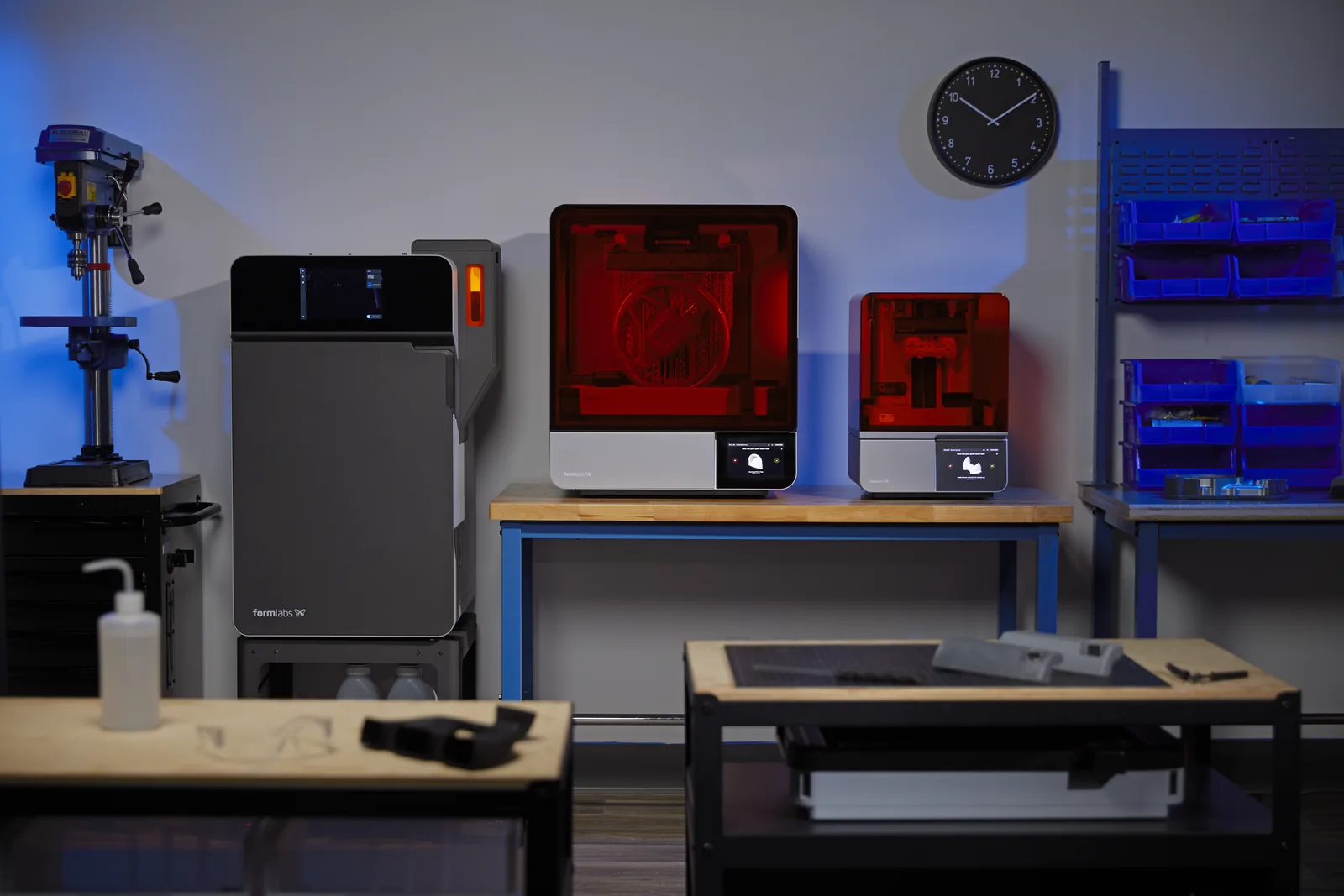
What Is 3D Printing and How It Works
3D printing — additive manufacturing, if you prefer the ISO term — builds a physical object layer by layer from a digital model instead of carving it out of a solid block. The idea is older than most people expect: Hideo Kodama experimented with laser-cured resin back in 1981, stereolithography was introduced in 1984, and Chuck Hull of 3D Systems shipped the first commercial SLA printer in 1987. The real explosion came after key patents expired around 2009, which dropped entry prices from industrial six figures to a few hundred dollars and put the technology on every engineer’s desk.
Every job that goes through our Kyiv workshop follows the same digital workflow:
- CAD design. The part is modeled in parametric CAD (Fusion 360, SolidWorks) for mechanical work, or sculpted or 3D-scanned for organic shapes. The mesh must be watertight, with sensible wall thicknesses and clearances.
- Export to STL. The model is converted to a triangle mesh (STL or 3MF). Resolution matters: too coarse and the faceting shows on the surface, while broken meshes with gaps can block printing entirely — so we repair files before they hit the queue.
- Slicing. Print-prep software — PreForm for our Formlabs machines, Cura-class slicers for FDM — cuts the model into layers and generates machine instructions. Orientation, supports, and layer height are decided here, and all three affect strength, surface, and price.
- Printing. The machine builds the part layer by layer, mostly unattended; jobs run from under an hour to several days depending on size, complexity, and quality settings.
- Post-processing. Support removal, IPA washing and UV post-curing for resins, powder recovery and blasting for SLS, then optional sanding, tumbling, or painting.
Why does this beat traditional subtractive machining for complex parts? A cutting tool has to physically reach every surface; a printer just keeps stacking layers. Internal channels, undercuts, lattices, and one-piece assemblies that would be impossible — or absurdly expensive — to mill come out of a printer at no extra cost. Complexity is essentially free: you pay for material and machine time, not for geometry.
3D Printing Technologies Compared
The ISO/ASTM 52900 standard defines seven additive process families. In practice, six technologies cover almost everything a business will ever order — and we run most of them in-house daily. Speed differences are real: in one Formlabs benchmark, the same gaming-controller assembly printed in 10 h 32 min on FDM, 2 h 36 min on SLA, and 3 h 52 min on SLS (plus cooling time). Here is how the technologies compare:
| Technology | How it works | Materials | Strengths | Limitations | Typical applications |
|---|---|---|---|---|---|
| FDM | Melts and extrudes thermoplastic filament through a nozzle, layer by layer | PLA, PETG, ABS, nylon, TPU, composites | Cheapest machines and materials; fast for simple parts | Lowest accuracy; visible layer lines; weak between layers | Concept models, quick prototypes, jigs and fixtures |
| SLA | Light source cures liquid photopolymer resin layer by layer | Standard, engineering, castable, and biocompatible resins (40+) | Best resolution and surface; isotropic; watertight | Some resins UV-sensitive; premium resins are pricey | Precise prototypes, dental, jewelry, end-use parts |
| SLS | Laser sinters polymer powder; unfused powder supports the part | Nylon PA12, PA11, filled nylons, PP, TPU | Strongest functional parts; no supports; batch nesting | Grainy surface; limited material range; costly hardware | Functional parts, small-series manufacturing, prosthetics |
| MJP (wax) | Printheads jet droplets of wax to build castable patterns | Casting wax | Extreme detail; burns out cleanly for lost-wax casting | Niche application; individual quoting | Jewelry and dental casting patterns |
| MJF | Inkjet array deposits fusing agent on nylon powder; heat fuses the layer | Nylon powders | Faster builds than SLS; very consistent mechanical properties | Industrial-scale hardware only | Production batches of functional parts |
| Metal (DMLS/SLM) | Laser sinters or melts metal powder layer by layer | Metal powders, up to superalloys | One-piece assemblies; internal channels; full density | Highest cost; industrial process | Aerospace, tooling, custom implants |
FDM is the workhorse: a heated nozzle lays down molten filament along a toolpath. It is the most widespread technology at consumer and office level — Fortune Business Insights notes that around 71% of businesses using 3D printing use FDM. Its weak spots are anisotropy (parts are weakest between layers) and surface quality, but for quick, cheap does-the-bracket-fit parts, nothing beats it.
SLA cures liquid photopolymer with a light source — originally a laser, in modern machines like our Formlabs Form 4 a fast LED/LCD engine that reaches up to 100 mm of vertical build per hour, finishing most jobs in under two hours. It delivers the best resolution and surface among polymer technologies and prints isotropic, watertight parts. Details on our SLA 3D printing service page.
SLS sinters nylon powder with a laser; the unfused powder supports the part, so no support structures are needed at all. That means full design freedom — interior features, undercuts, thin walls — plus the ability to nest dozens of parts in a single build, which is why SLS wins on cost per part at volume. We run a Formlabs Fuse 1+ 30W; see the SLS 3D printing service page.
MJP wax is material jetting: printheads jet droplets of castable wax to build patterns for lost-wax casting. Our ProJet 2500W produces jewelry and dental patterns that burn out cleanly — a niche where no other technology matches the detail.
MJF (HP Multi Jet Fusion) also fuses nylon powder, but with an inkjet-deposited fusing agent and heat instead of a laser — builds run faster than SLS with very consistent mechanical properties, which suits production runs.
Metal printing (DMLS/SLM) melts metal powder with a laser. It consolidates multi-part assemblies into single components with internal channels, at densities matching conventionally made metal, and even superalloys are processable. It remains the most expensive route and lives firmly in industrial territory.
Accuracy, Tolerances, and Surface Quality
Three terms get mixed up constantly, so let’s untangle them. Accuracy is how closely the printed part matches the CAD model — shots landing near the bullseye. Precision is repeatability: whether ten prints of the same part come out identical, even if all are offset the same way. Tolerance is the variance you are willing to accept, and only you can define it, because it depends on the application. The classic manufacturing rule applies here too: every step tighter in tolerance costs more in production and quality control, so specify the loosest tolerance that still works.
Typical dimensional tolerances by technology, per Formlabs’ engineering guidance:
- SLA/DLP (resin): ±0.15% for features 1–30 mm, ±0.2% for 31–80 mm, ±0.3% for 81–150 mm, with a floor of ±0.02 mm. In a dental-model test on the Form 4, over 99% of the printed surface fell within 100 microns of the design.
- SLS/MJF (powder): ±0.5% or ±0.3 mm, whichever is larger — on par with standard CNC machining tolerances of ±0.3 mm.
- FDM: ±0.5% with a floor of ±0.5 mm — the loosest of the three.
Resin and powder printing sit between standard and fine machining. If a feature needs better than about 0.025 mm, plan to machine it after printing. One caveat worth repeating: a printer’s advertised XY or Z resolution says nothing about how accurate the finished part will be — the whole ecosystem decides that: print-prep software, calibration, material quality, and post-processing. Resin parts shrink slightly during post-curing, which good software (Formlabs PreForm) compensates automatically; stiffer materials hold thin features better than flexible ones; and on FDM, higher-temperature materials warp more — ABS shrinks more on cooldown than PLA.
Surface finish follows the same ranking. FDM shows visible layer lines and needs sanding for a presentable surface. SLA produces a smooth matte finish genuinely hard to distinguish from injection molding. SLS comes out slightly grainy but uniform across the whole part, and vapor smoothing can bring it to a glossy, SLA-like state.
3D Printing Materials
Material choice is half the technology choice, so here is the honest map.
FDM thermoplastics. PLA is the easy default for visual models; PETG adds toughness; ABS takes heat better but warps during printing; TPU is flexible; nylon is the strongest of the common filaments. Composites and high-temperature polymers like PEEK cover special cases. Filament is cheap — $50–150/kg for standard grades — and shelf-stable, so it never expires on the spool.
SLA resins. The widest catalogue in polymer printing: Formlabs alone formulates over 40 resins — standard resins for visual parts; tough and rigid engineering grades (ABS-like, PP-like, glass-filled); flexible and heat-resistant options; biocompatible dental and medical resins; castable resins for jewelry; plus flame-retardant, ESD-safe, and silicone materials. Standard and engineering resins run $100–200/L (Formlabs general-purpose starts at $79/L); biocompatible grades reach $200–500/L.
SLS powder. Nylon PA12 is the workhorse — strong, stable, and suitable for end-use parts; PA11, glass- and carbon-filled nylons, polypropylene, and TPU round out the range. Powder costs around $100/kg, and unfused powder is reusable, which lowers the effective cost per part.
Casting wax. Our MJP machine prints pure wax patterns for lost-wax casting — jewelers get the detail of a hand-carved master with the repeatability of a digital file.
Metals, briefly. DMLS/SLM systems process metal powders up to superalloys with density comparable to conventionally made metal — but at industrial prices, so for most clients the practical first question is whether a strong PA12 or glass-filled nylon part does the job.
How Much Does 3D Printing Cost?
Four factors drive the price of a printed part: material volume (a hollowed part with light infill costs a fraction of a solid one), technology (resin and powder cost more per gram than filament), post-processing (washing, curing, smoothing, and painting all add labor), and quantity (SLS parts nest in a single build, so unit cost falls sharply in batches). Our service prices, per gram of finished part:
| Technology and material | Price per gram | Minimum order | Lead time |
|---|---|---|---|
| FDM — PLA | from 8 UAH/g | 300 UAH | from 24 h (express 6–12 h) |
| FDM — PETG | from 12 UAH/g | 300 UAH | from 24 h (express 6–12 h) |
| FDM — nylon | from 25 UAH/g | 300 UAH | from 24 h (express 6–12 h) |
| SLA — standard resins | from 15 UAH/g | 500 UAH | from 24 h (express 6–12 h) |
| SLA — biocompatible and castable resins | from 30 UAH/g | 500 UAH | from 24 h |
| SLS — nylon PA12 | from 23 UAH/g incl. VAT | no minimum | batches in 3–5 days |
| MJP — casting wax | individual quote | no minimum | on request |
Prices are in Ukrainian hryvnia; as a rough guide at recent exchange rates, 10 UAH is about €0.20. FDM and SLA orders ship from 24 hours, with 6–12 hour express available; SLS batches take 3–5 days.
One nuance clients often miss: price per gram is not price per part. The same model can weigh several times more or less depending on infill, hollowing, orientation, and support strategy — so two quotes for “the same part” can legitimately differ severalfold. That’s why we built an online calculator: upload an STL, see a live 3D preview, and get a volume-based estimate in seconds, before talking to anyone.
How to Choose the Right Technology
After 12,000+ completed orders since 2015, most requests fall into a handful of patterns. Match yours:
- Prototype by tomorrow, budget-first → FDM. Cheapest per gram, ready from 24 hours, express in 6–12. Perfect for fit checks and proof-of-concept models.
- Precise small part, master model, smooth surface → SLA. Tolerance floor of ±0.02 mm, walls down to 0.2 mm, a finish close to injection molding.
- Functional part or a small batch, no support scars → SLS in nylon PA12. Near injection-molded mechanics, full design freedom, batch nesting in one build.
- Jewelry or dental casting → MJP wax patterns. Clean burnout and detail no other process matches.
- Series of 100+ identical parts → MJF or, once the design is frozen, injection molding — at hundreds of units, per-part economics start favoring tooling.
And a pattern worth copying from industry: companies that use 3D printing seriously rarely stick to one technology. Formlabs cites manufacturers like Brose and Labconco running FDM, SLA, and SLS side by side — each for what it does best. If you’re unsure, send us the model and describe the application; we quote across all of our technologies at once.
Where 3D Printing Is Used
Prototyping remains the number-one use — Fortune Business Insights reports that over 68% of companies use 3D printing for prototypes — but end-use applications are catching up fast. Where we see it working, both globally and in our own order book:
- Medicine and dentistry: anatomical models for surgical planning, surgical guides, crown-and-bridge and clear-aligner models, dentures, made-to-measure implants and hearing-aid shells built from body scans, orthotics and prosthetics.
- Jewelry: lost-wax casting patterns, master molds, and fitting pieces — the single biggest workload of our wax MJP machine.
- Automotive: rapid prototyping, weight reduction, and out-of-production spares; automotive was the largest end-user segment of the market in 2024, per Fortune Business Insights.
- Aerospace: light, geometrically complex single-piece components such as blisks — the textbook case for part consolidation.
- Consumer products: low-volume and bridge manufacturing, customized goods, props and models for film and entertainment.
- Education and R&D: affordable FDM machines have made physical iteration a normal part of coursework and lab work.
The market behind all this is neither small nor slowing. The Wohlers Report 2026 puts global additive-manufacturing revenue at $24.2 billion for 2025, up 10.9% year over year, with services now the primary growth engine. Fortune Business Insights forecasts the market reaching $136.76 billion by 2034 at a 21.6% CAGR. Analyst totals differ depending on what gets counted — hardware, software, services — but the direction is unanimous.
3D Printing vs CNC Machining vs Injection Molding
We sell 3D printing, but we won’t pretend it wins everywhere. The honest breakdown:
3D printing wins at low volumes and high complexity. Protolabs puts the sweet spot at 1–50 parts; TWI draws the economic line at roughly 100 units, beyond which CNC and injection molding pull ahead. Within that zone, Formlabs estimates the right parts can cost up to 95% less printed than machined, molded, or outsourced. Add unmatched geometric freedom — internal channels, consolidated assemblies — and zero tooling cost, which means a design change tomorrow costs nothing today.
CNC machining wins when tolerances get serious. Resin and powder printing sit between standard and fine machining, but any feature tighter than about ±0.025 mm has to be cut, not printed. CNC also wins on the material properties of solid stock and on metals, where printing costs remain industrial. A common hybrid we use ourselves: print the complex part, then machine the one or two critical surfaces.
Injection molding wins on volume, full stop. Once a design is frozen and quantities run into the hundreds and thousands, amortized tooling drives per-part cost below anything additive can reach. Printing still earns its keep here — as bridge production while the mold is being made, and as printed mold inserts and casting patterns during tooling development.
The practical strategy we recommend: prototype and iterate additively, launch with bridge production on SLS or MJF, and switch to molding when volume justifies the tool.
How to Get Started
Two ways in, depending on whether you need parts or capability.
Path 1: order printing as a service. If you need parts, not printers: upload your STL to the online calculator, check the live 3D preview and the volume-based price, and confirm the order. FDM and SLA jobs ship from 24 hours; express orders in 6–12 hours can be picked up same day in Kyiv, and we deliver across Ukraine. Since 2015 we’ve completed more than 12,000 orders on our own fleet — Formlabs Form 4 and Form 3+ (SLA), Fuse 1+ 30W (SLS), a ProJet 2500W for casting wax, an FDM park, and professional 3D scanners for reverse engineering. If the file isn’t ready or the task is unusual, talk to our engineers first — we’ll help with design-for-printing decisions before you spend a hryvnia.
Path 2: buy a printer. If printing is becoming a regular part of your workflow, owning the machine pays back quickly — professional desktop SLA runs $2,500–10,000, and a full benchtop SLS ecosystem about $60,000. As the official Formlabs distributor in Ukraine, we supply, install, and support the same Form and Fuse machines we run in production every day — so the advice you get comes from operating experience, not a spec sheet.
Either way, the first step is identical: upload a model to the calculator and see the numbers for yourself.
Frequently Asked Questions
What is 3D printing in simple terms?
3D printing is a manufacturing process that builds a physical object layer by layer from a digital 3D model, instead of cutting it from a solid block. You design a part in CAD, software slices it into thin layers, and the printer deposits or cures material layer after layer until the part is complete. It is fastest and cheapest exactly where traditional methods struggle: complex shapes, one-offs, and small batches.
How much does 3D printing cost in Ukraine?
At 3DPrint.ua, FDM printing starts at 8 UAH per gram for PLA, SLA at 15 UAH per gram for standard resins, and SLS nylon PA12 at 23 UAH per gram including VAT. Minimum orders are 300 UAH for FDM and 500 UAH for SLA. The final price depends on part volume, infill, and post-processing, so upload your STL to our online calculator for an instant volume-based estimate.
Which 3D printing technology should I choose?
Choose FDM for fast, inexpensive prototypes and fit checks; SLA for high precision, smooth surfaces, and dental or castable resins; SLS for strong functional parts and small batches without support structures; and MJP wax for jewelry casting patterns. For series of 100 or more identical parts, compare MJF and injection molding. If in doubt, send us the model — we quote across all technologies at once.
How accurate is 3D printing?
It depends on the technology. SLA resin printing holds about ±0.15% on features up to 30 mm with a lower floor of ±0.02 mm; SLS and MJF powder printing hold ±0.5% or ±0.3 mm, whichever is larger — on par with standard CNC machining; FDM is the loosest at ±0.5% with a ±0.5 mm floor. Features that need tighter than about 0.025 mm are usually machined after printing.
What materials are used in 3D printing?
Thermoplastics such as PLA, PETG, ABS, TPU, and nylon for FDM; over 40 photopolymer resins for SLA, including tough engineering grades, biocompatible dental resins, and castable resins; nylon PA12 powder for SLS; pure wax for casting patterns; and metal powders up to superalloys on industrial DMLS/SLM systems. We stock the common FDM, SLA, and SLS materials in Kyiv and can source specialty grades on request.
Where can I order 3D printing in Ukraine?
3DPrint.ua is a Kyiv-based 3D printing service operating since 2015, with more than 12,000 completed orders and an in-house fleet covering FDM, SLA, SLS, and wax MJP. We are the official Formlabs distributor in Ukraine and print on the same machines we sell. Upload your model to the online calculator for an instant quote; express orders are ready in 6–12 hours with same-day pickup in Kyiv, and we ship across Ukraine.
Need parts printed in Ukraine?
Send us your STL or STEP file — an engineer will reply with a quote within 30 minutes during business hours. Pickup in central Kyiv or delivery across Ukraine.
Send your STL/STEP — quote within one hour
Official Formlabs distributor in Ukraine, production facility in Kyiv, international shipping on request.