
SLS vs SLA — Which to Choose
SLS vs SLA both build parts layer by layer, but they solve different problems. SLS fuses nylon powder into tough, near-isotropic functional parts and needs no support structures. SLA cures liquid resin into ultra-smooth, high-detail parts that need supports and are more brittle. Choose SLS for durable end-use parts and batches; choose SLA for fine detail, dental, jewelry, and visual models.
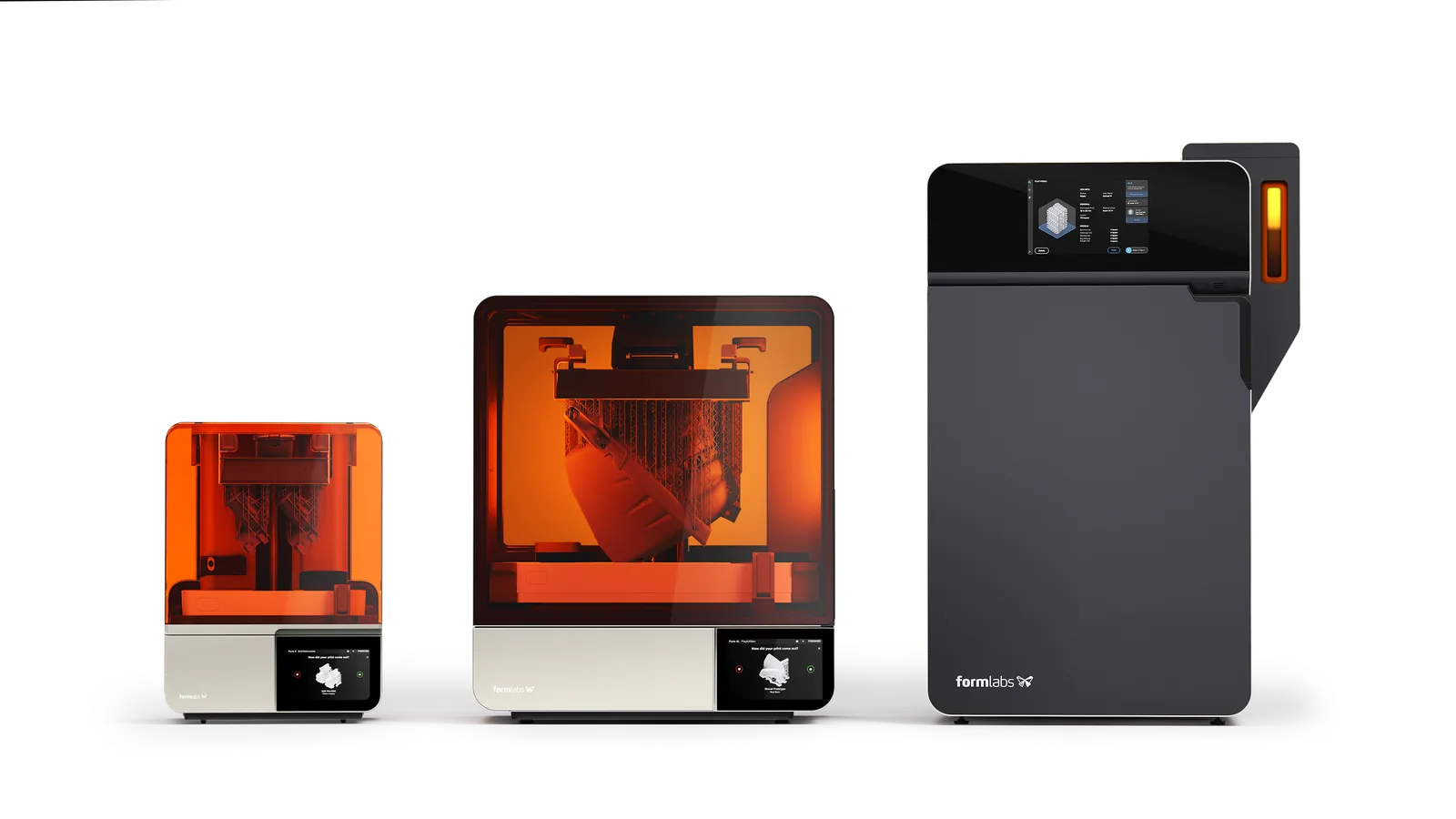
We run both processes in our own production shop in Kyiv — a Formlabs Fuse 1+ 30W for SLS nylon and Formlabs Form 4 / Form 4L LFS machines for resin — so the comparison below is what we actually see on parts coming off the build platform, not spec-sheet theory.
SLS vs SLA: full comparison table
| Parameter | SLS (powder sintering, nylon) | SLA / LFS (resin) |
|---|---|---|
| How it works | A laser sinters polymer powder, layer by layer; loose powder surrounds the part | A laser (LFS) or LCD/UV cures liquid photopolymer resin layer by layer |
| Support structures | None — the powder bed supports everything | Required — supports must be added and removed by hand |
| Material strength (tensile) | Nylon PA12 ~48–50 MPa; PA11 CF / Nylon 11 CF ~69 MPa | Typically ~30–65 MPa depending on resin; engineering resins reach the upper end |
| Isotropy | Near-isotropic — similar strength in all directions | Largely isotropic, but most resins are more brittle (low elongation) |
| Toughness / durability | High — survives drops, snaps, living hinges (PA11) | Lower — standard resin is brittle and cracks under impact |
| Surface finish | Matte, slightly grainy (powder texture) | Very smooth, glossy; finest detail of any common process |
| Minimum feature / detail | Good, but soft edges; ~0.3–0.5 mm walls | Excellent — crisp text, sharp edges, fine lattices |
| Complex / captive geometry | Excellent — interlocking, enclosed cavities, assemblies in one build | Limited by supports inside cavities and resin drainage |
| UV / environmental stability | Stable; nylon is chemically resilient | UV-sensitive — most resins yellow and embrittle in sunlight over time |
| Biocompatible grades | Yes (medical nylon grades exist) | Yes — certified dental and medical resins |
| Best for | Functional parts, batches, jigs, ducts, enclosures, end-use | Dental, jewelry, casting, miniatures, visual prototypes, master patterns |
| Batch economics | Excellent — nest dozens of parts in one powder volume | Good for small visual runs; supports add hand-finishing labor |
Which is stronger, SLS or SLA?
SLS wins on real-world durability for most functional parts. Sintered nylon PA12 lands around 48–50 MPa tensile with roughly 11% elongation, and because the powder bed fuses the part evenly, strength is near-isotropic — there is no weak layer-adhesion axis the way there is on FDM. Drop an SLS nylon bracket and it tends to flex or bounce; PA11 even survives repeated living-hinge cycles. Carbon-filled grades (Nylon 11 CF) push tensile strength to ~69 MPa with high stiffness and heat resistance.
SLA resin can post a respectable tensile number on paper, and engineering resins (tough, durable, rigid families) genuinely close part of the gap. But standard resin is brittle: it resists a static load fine, then cracks rather than bends under impact or fatigue. For a part that gets dropped, snapped together, or loaded repeatedly, SLS is the safer engineering choice. For a part that mostly has to look right and hold a precise shape, resin’s brittleness rarely matters.
Which is more detailed and smoother?
SLA, clearly. Resin is the detail king of common 3D printing processes — it reproduces crisp lettering, sharp corners, thin walls, gem settings, and fine surface texture that SLS simply can’t hold. Straight off the platform an SLA part is smooth and glossy; an SLS part is matte with a fine powder grain you can feel.
That said, SLS finish is genuinely good and consistent — and it’s uniform on every face at once, including internal surfaces a resin support would have scarred. We bead-blast and can dye SLS nylon to an even professional matte. So the honest framing is: SLA for fine detail and a flawless show surface; SLS for a uniform, functional, support-mark-free finish across complex geometry.
Which is cheaper?
It depends almost entirely on part count and geometry, not on a simple per-cm³ rate.
- One or a few simple parts: SLA is often cheaper to set up and run, and resin printers are quick for small visual jobs.
- Complex parts or batches: SLS usually wins. Because there are no supports, you nest parts in 3D throughout the whole powder volume — dozens of parts per build — and there’s no per-part support removal labor. That nesting is why SLS unit cost drops fast as quantity rises.
- Hidden labor: every SLA part carries hand-finishing time (cut supports, sand witness marks, wash, UV-cure). SLS parts mainly need depowdering and an optional blast. On a batch, that labor difference dominates the quote.
For context on throughput: a benchtop Fuse 1+ 30W fits a 165×165×300 mm build, while industrial SLS in the Fuse X1 class (330×330×565 mm, 120 W fiber laser, nitrogen atmosphere) runs on the order of ~9,693 parts/week — roughly 3× legacy SLS at about half the part cost. That’s the regime where SLS becomes cheaper than almost anything for functional volume.
Which for dental and jewelry?
SLA, without much debate. Resin LFS is the workhorse for dental models, surgical guides, castable jewelry patterns, and anything that has to be cast or worn. The reasons are exactly resin’s strengths: ultra-fine detail for gem seats and tooth anatomy, a smooth surface that needs minimal polishing, and certified biocompatible and castable resins formulated for these workflows. A castable resin pattern burns out cleanly for lost-wax casting; sintered nylon does not.
SLS does have a place in medical — durable, biocompatible nylon for prosthetic and orthotic structures, jigs, and functional device housings — but for the detail-and-castability core of dental and jewelry, resin is the right tool. See our SLA / resin 3D printing service for the dental and jewelry resin families we run.
Which for functional, end-use parts?
SLS, in most cases. This is where powder sintering is hard to beat: tough isotropic nylon, no supports, and the freedom to print geometry that no other affordable process can — lattices, internal channels, snap-fits, living hinges, and captive assemblies that come out of the powder already moving. Enclosures, ducting, brackets, manifolds, cable guides, and short-to-mid production runs are textbook SLS.
You’d still pick resin for a functional part when fine detail or a flawless surface outranks toughness — a precise fixture, a master pattern, a transparent flow-visualization part, or a small assembly where dimensional crispness matters more than impact resistance. Engineering resins also serve specific needs (high stiffness, heat deflection, clarity) that nylon can’t. Full process details are on our SLS nylon 3D printing service page.
Bottom line: how to choose
Pick the process from the part, not the brochure:
- Choose SLS when the part must work: functional, durable, isotropic, complex geometry, captive assemblies, batches, or end-use nylon parts — and a matte finish is fine.
- Choose SLA when the part must look right and hold fine detail: dental, jewelry, casting patterns, miniatures, visual prototypes, and smooth show surfaces — and you can accept supports plus more brittleness.
- Still unsure? The deciding questions are: Will it be dropped or loaded? (SLS). Does it need crisp detail or a flawless surface? (SLA). Is it dental/jewelry/castable? (SLA). Is it a batch of functional parts? (SLS).
We run both SLS and SLA in-house in our Kyiv shop, so we’re glad to recommend the process on engineering merit — and if it helps, print one test part of your model in each so you can judge strength, detail, and finish in your own hands before committing to a batch.
Frequently asked questions
Is SLS stronger than SLA?
Should I use SLS or SLA for dental and jewelry?
Which is cheaper, SLS or SLA?
Send your STL/STEP — quote within one hour
Official Formlabs distributor in Ukraine, production facility in Kyiv, international shipping on request.