
SLA resin 3D printing service
Form 4 and Form 4L stereolithography in our Kyiv production shop. 25 micron resolution, smooth-as-moulded surfaces, and the full Formlabs material library — Standard, Tough, Rigid, Clear, Castable Wax, BioMed and Dental. From one master model to a tray of parts.
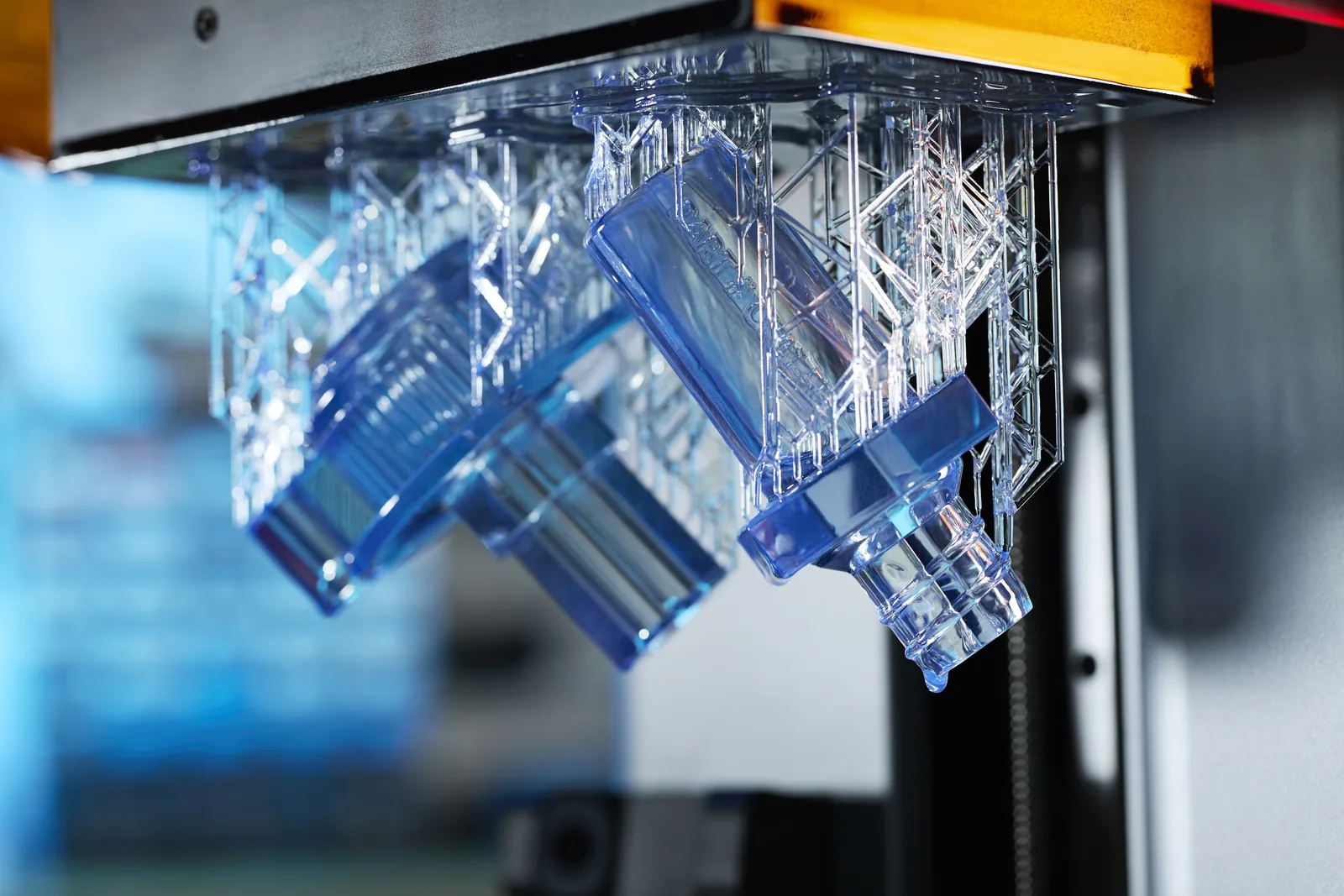
SLA (stereolithography) is the right 3D printing process when surface finish and fine detail matter more than mechanical toughness. A UV laser cures liquid resin layer by layer, producing parts with crisp features down to ~25 microns and a smooth, near-moulded surface — ideal for jewelry masters, castable patterns, dental models, visual prototypes, and microfluidics. The trade-off: resin parts are more brittle than SLS nylon, need support structures, and age under UV.
When does resin (SLA) beat SLS and FDM?
We run FDM, SLA and SLS side by side in-house, so we choose the process on engineering merit, not on what is loaded that day. SLA wins whenever the deliverable is judged by the eye or by a fine feature rather than by load:
- Fine detail & sharp edges — text, fillets, knurls and lattices that FDM’s nozzle smears and that SLS powder rounds off.
- Smooth, paint-ready surface — straight off the printer SLA reads as moulded; SLS PA12 is matte/grainy, FDM shows layer lines.
- Jewelry & casting — Castable Wax burns out clean for lost-wax investment casting of rings and findings.
- Dental & medical models — accurate arches, surgical-planning models, splint and aligner workflows (BioMed/Dental families; biocompatible grades on the certified Form 4B).
- Visual & presentation models — design reviews, transparent housings and light pipes in Clear resin.
- Microfluidics & fine channels — small internal features and optically clear flow paths.
SLS is the better call when the part has to work mechanically — living hinges, snap-fits, functional brackets, captive assemblies and small batches that need near-isotropic nylon strength with no supports. FDM is the better call when the part is large, simple, or a throw-away iteration where cost-per-part dominates. If you are weighing the two powder-vs-resin routes directly, see our SLS vs SLA comparison and our SLS nylon printing service.
| Factor | SLA / resin (LFS) | SLS nylon | FDM |
|---|---|---|---|
| Detail / min feature | Highest (~25 micron XY) | Good | Coarse |
| Surface finish | Smooth, near-moulded | Matte, grainy | Visible layer lines |
| Mechanical strength | Moderate; can be brittle | Tough, near-isotropic | Anisotropic (weak Z) |
| Supports | Required | None (loose powder) | Required |
| UV / outdoor stability | Ages under UV | Stable | Material-dependent |
| Best for | Detail, casting, dental, visual | Functional parts, small batches | Large, simple, cheap iterations |
What we print on: Form 4 and Form 4L
Both machines use Formlabs’ LFS (Low Force Stereolithography) — a flexible film tank and an LED light engine that keeps peel forces low, so fine features survive and supports tear off cleanly. The Form 4L is the large-format version of the same process for parts up to a third of a metre tall.
| Spec | Form 4 | Form 4L (large format) |
|---|---|---|
| Technology | LFS 2.0 | LFS 2.0 |
| Build volume | 200 × 125 × 210 mm | 350 × 200 × 350 mm |
| XY resolution | 25 microns | 25 microns |
| Layer height | 25 / 50 / 100 / 200 microns | 25 / 50 / 100 / 200 microns |
| Print speed | up to 100 mm/hr | up to 100 mm/hr |
| Medical grades | Standard library (Form 4B adds ISO 13485 / FDA 510(k)) | Standard library |
Every part is post-processed properly: solvent wash (Form Wash) to remove uncured resin, support removal, then UV post-cure (Form Cure) to bring the resin to its rated mechanical properties. Skipping the cure is the single most common reason a resin print stays tacky and weak — we don’t ship un-cured parts.
Which resin should you choose?
Resin selection drives both how the part performs and what it costs. We carry the main Formlabs families; pick by job, not by name:
| Resin family | Character | Use it for |
|---|---|---|
| Standard / Grey / White | Crisp detail, matte finish | Visual prototypes, form models, concept parts |
| Tough / Durable | More ductile, impact-tolerant | Snap-fits, living-ish hinges, assemblies, jigs |
| Rigid (Rigid 10K / Rigid 4000) | Glass-filled, stiff, heat-resistant | Brackets, fixtures, thin stiff features, tooling |
| Clear | Transparent after polish | Light pipes, fluidics, see-through housings |
| Castable Wax | Clean burnout, low ash | Lost-wax casting of jewelry & fine metal parts |
| BioMed | Biocompatible (certified) | Anatomical models, medical devices (on Form 4B) |
| Dental | Application-specific (models, splints, temporaries) | Dental labs & clinics (certified workflows on Form 4B) |
Not sure? Send the model with the working conditions — load, transparency, whether it gets cast, whether it touches skin — and we’ll spec the resin and orientation for you.
Honest limits of resin printing
A resin part is the wrong choice for some jobs, and we’ll say so. The real constraints:
- UV ageing. Most resins yellow and slowly embrittle under sustained sunlight/UV. For permanent outdoor or load-bearing parts, SLS nylon or FDM is the more durable route.
- Brittleness. Standard resins are stiffer and more brittle than nylon. Where the part must absorb impact or flex repeatedly, move to Tough/Durable — or to SLS PA11.
- Supports & touch-points. Overhangs need supports; their contact points leave small witness marks that we sand back, but deep internal surfaces can be hard to reach.
- Trapped resin & cure depth. Fully enclosed hollows trap liquid resin — they need a drain/vent hole, which we’ll flag before printing.
- Thermal limits. Apart from the Rigid/high-temp grades, resin softens at modest temperatures; it is not a structural engineering plastic for hot environments.
What does SLA printing cost and how long does it take?
Resin price scales with part volume (cured material) plus post-processing, not with footprint — a tall thin part can cost less than a small solid block. Detail level (layer height) drives print time: a 50 micron job prints faster than the same part at 25 microns, with little visible difference on many geometries. Typical turnaround in our Kyiv shop is a few working days including wash, support removal and full UV cure; rush jobs are possible. For a real number, send an STL/STEP and we’ll quote the part, the recommended resin and the layer height for your detail target.
Reverse-engineer a physical part first?
If you have a physical object but no CAD, we can 3D scan it with metrology-grade scanners (down to ±0.01 mm for jewelry-scale detail), rebuild the geometry, and print the master in resin — a common path for replacement parts, restoration and jewelry masters.
Bottom line: how to choose
Choose SLA resin when the part is judged by its surface and detail — visual models, dental and medical models, microfluidics, and especially jewelry masters and castable patterns. Accept that it needs supports, post-curing, and shelter from UV. Choose SLS when the part must be a tough, support-free functional component or a small production batch; choose FDM when it’s large, simple, or a cheap throw-away iteration. We run all three in Kyiv, so the recommendation you get is the one that fits the part — not the one that sells a printer.
Form 4 / Form 4L specifications (build volume, 25 micron XY, layer heights, print speed) and Formlabs resin families are per Formlabs published machine and material data. Process recommendations reflect our own in-house FDM/SLA/SLS production experience in Kyiv since 2015.
Frequently asked questions
Is SLA stronger than SLS or FDM?
What is the most accurate, smoothest 3D printing for jewelry and casting?
Do resin (SLA) prints last outdoors or under sunlight?
New to additive manufacturing? Start with our complete guide to 3D printing — technologies, tolerances, materials and costs explained.
Get your resin part quoted
Send an STL or STEP. We'll print it on Form 4 / 4L in Kyiv, recommend the resin and layer height for your detail target, and ship a properly washed and UV-cured part. Shipping across Ukraine.