
SLS 3D Printing — PA12 (Nylon 12)
PA12 (Nylon 12) is the default workhorse material for SLS 3D printing. Laser-sintered PA12 reaches roughly 48–50 MPa tensile strength with about 11% elongation, prints near-isotropic with no support structures, resists most fuels, oils and solvents, and comes in biocompatible grades. It is the material most functional SLS parts should start with — housings, ducts, brackets and snap-fits.
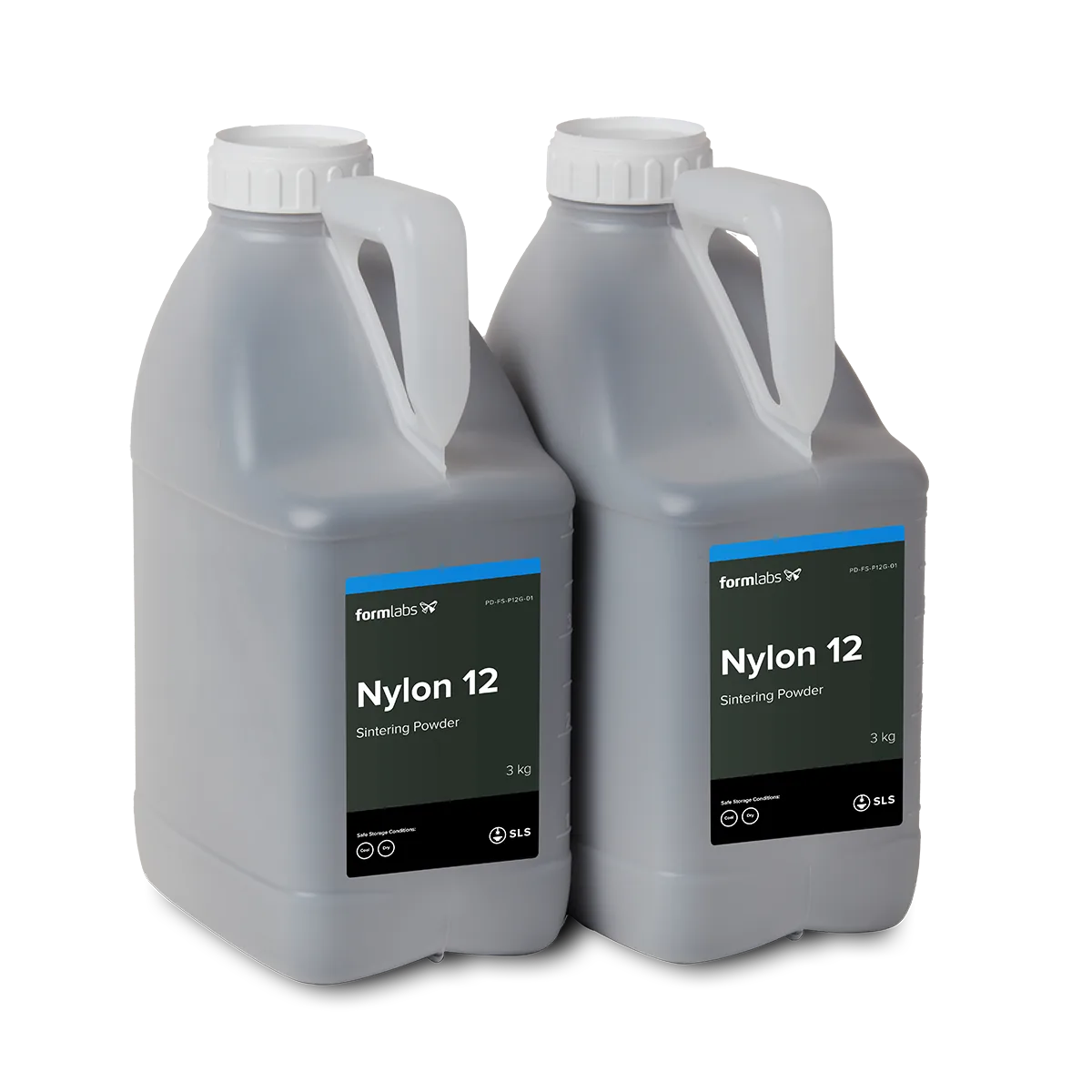
What is PA12 (Nylon 12) and why is it the SLS default?
PA12 is a semi-crystalline polyamide supplied as a fine powder (~50–60 µm particles). In selective laser sintering, a CO₂ or fiber laser fuses each layer inside a heated powder bed held just below the polymer’s melting point, so the surrounding loose powder supports the part — there are no support structures to remove and no anisotropy penalty from a build plate. PA12 became the industry default because it has a wide, forgiving sintering window, recycles reasonably between builds, and lands in a sweet spot of strength, toughness, chemical resistance and detail that covers most functional-part jobs.
Because the powder bed carries the load, SLS prints geometry that FDM and SLA struggle with: internal channels, conformal lattices and captive assemblies in a single job, with no support scars. That is the structural reason PA12 dominates functional and small-to-mid-batch production. For the full process and machine context, see our SLS 3D printing overview.
PA12 material properties (typical SLS values)
The numbers below are representative for laser-sintered PA12 in the as-printed (untreated) state. Exact figures vary by powder brand, refresh ratio and machine, but the ranges are stable enough to design against.
| Property | Typical value | Notes |
|---|---|---|
| Tensile strength | ~48–50 MPa | Near-equal X/Y/Z |
| Elongation at break | ~11% | Ductile enough for snap-fits |
| Tensile / flexural modulus | ~1.6–1.8 GPa | Stiff but not brittle |
| Heat deflection (0.45 MPa) | ~160–170 °C | Drops sharply under load at 1.8 MPa (~95 °C) |
| Density (sintered) | ~0.95–1.0 g/cm³ | ~3–8% residual porosity |
| Anisotropy | Near-isotropic | No weak Z layer-adhesion plane like FDM |
| Surface finish | Matte, slightly grainy | ~Ra 8–12 µm as-printed |
| Min. wall thickness | ~0.8–1.0 mm | 0.5 mm possible on small parts |
| Chemical resistance | Good | Fuels, oils, greases, many solvents; absorbs some water |
| Biocompatibility | Grades available | Skin-contact / sterilizable grades exist (grade-dependent) |
Values are typical engineering ranges for laser-sintered PA12, as-printed. Always confirm against the specific powder’s datasheet for a regulated or load-bearing application.
What are PA12’s strengths?
- Near-isotropic strength. Unlike FDM, a PA12 part is roughly as strong pulled along Z as along X/Y — you design for one strength number, not a weak layer plane.
- No supports, complex geometry for free. Loose powder holds the part, so lattices, internal ducts, captive hinges and nested assemblies print in one job with no support removal.
- Tough and functional. ~11% elongation means snap-fits, clips and press-fits survive real assembly cycles instead of cracking like resin.
- Chemically robust. Shrugs off fuels, oils, greases and many solvents — good for under-hood, fluid-handling and industrial parts.
- Stable and repeatable. A well-characterized powder gives consistent dimensions build-to-build — what makes small-batch end-use production viable.
- Finishes and dyes well. The porous matte surface takes bead-blasting, tumbling, vapor smoothing and immersion dyeing — most commonly a deep black.
What are PA12’s limits?
Honest constraints we see on the shop floor:
- Porosity. As-printed PA12 is ~3–8% porous, so it is not airtight or fully watertight without post-processing (vapor smoothing, sealing or infiltration).
- Moisture uptake. Like all nylons it absorbs ambient water, which slightly shifts dimensions and toughness; condition parts for tight-tolerance metrology.
- Heat under load. Fine for ~80–90 °C service, but it softens well below its melt point when mechanically loaded — for hot structural parts step up to PA-CF.
- Matte, grainy surface. Excellent for engineering, but not the glass-smooth cosmetic finish of SLA resin without extra finishing.
- UV and long-term color. Natural PA12 yellows in sun over time; dyeing black and a UV-resistant coat help outdoor parts.
- Stiffness ceiling. At ~1.7 GPa it is stiff but not rigid — thin unsupported spans flex. Carbon-filled nylon is the fix.
What is PA12 best used for?
PA12 is the right first choice whenever you need a real functional part rather than a look-and-feel model. Typical jobs we print:
- Enclosures and housings for electronics and instruments, with integrated bosses, ribs and snap-fit lids.
- Ducts, manifolds and fluid channels with smooth internal curves impossible to mold or machine cheaply.
- Brackets, mounts and clips — lightweight, vibration-tolerant structural hardware.
- Snap-fits and repeated-flex features (PA12 handles many snap cycles; for true living hinges, PA11 is better).
- Jigs, fixtures and manufacturing aids that must survive a shop environment.
- End-use production parts in small-to-mid batches — drones, automotive, robotics, medical devices (biocompatible grades), spare parts on demand.
Finishing and black dyeing PA12
PA12 leaves the printer a pale grey-white with a uniform matte texture. Because the surface is microporous, it is one of the easiest 3D-printing materials to post-process:
- Bead blasting — standard first pass; removes loose powder and evens the finish.
- Tumbling / vibratory polishing — knocks down edges and smooths for a more uniform feel on batches.
- Vapor smoothing — chemically melts the outer skin to a sealed, semi-gloss surface; this is what makes PA12 effectively watertight and far easier to clean.
- Dyeing — parts are immersed in a hot dye bath. Black is by far the most common: the porous nylon absorbs dye into the surface (not just a coating), giving a consistent, robust deep-black color that won’t chip like paint. Other colors are possible, but black is the production standard.
- Coating / sealing — optional for UV resistance, extra wear resistance or a specific gloss level.
One practical note from our shop: dye penetrates only a fraction of a millimeter, so heavily abraded areas can show lighter. For cosmetic black parts, vapor-smooth first, then dye.
PA12 vs PA11 vs PA-CF: which nylon should you pick?
All three are SLS nylons printed support-free, but they trade off ductility, stiffness and temperature differently. Quick rule: PA12 for general-purpose functional parts, PA11 when you need toughness and flex (impact, living hinges), PA-CF (carbon-filled Nylon 11/12) when you need stiffness and heat.
| Property | PA12 (Nylon 12) | PA11 (Nylon 11) | PA-CF (Nylon 11/12 CF) |
|---|---|---|---|
| Tensile strength | ~48–50 MPa | ~48 MPa | ~69 MPa |
| Elongation at break | ~11% | ~30–40% | ~4–10% |
| Stiffness | Medium (~1.7 GPa) | Lower (more flexible) | High |
| Toughness / impact | Good | Excellent | Lower (stiffer, less ductile) |
| Heat resistance | Good | Good | Highest |
| Surface / handling | Smooth matte | Smooth matte | Coarser; fibers are abrasive to handle |
| Best for | Housings, ducts, brackets, snap-fits, general end-use | Living hinges, impact parts, sports/wearables, clips | Stiff structural brackets, hot-environment parts, jigs under load |
In practice, most jobs that land on our SLS line stay on PA12 — it is the cheapest of the three, the best characterized, and strong enough. Move to PA11 only when a part must flex repeatedly or take impact (a clip that snaps thousands of times, a thin living hinge). Move to PA-CF (carbon-filled nylon) when stiffness or heat is the limiting factor and you can accept a rougher, abrasive-to-handle surface and lower ductility. For a deeper side-by-side with test numbers, see PA12 vs PA-CF.
How much does PA12 SLS cost?
SLS pricing is driven mostly by the powder a part consumes and how densely the build chamber packs (nesting), not by part complexity — geometry that costs money in FDM supports or CNC time is essentially free in SLS. So small, dense, nestable parts in a full build are the most economical, and internal features cost no extra. The honest trade-off versus FDM: PA12 has a higher entry cost for a one-off, but wins on functional quality, isotropy and per-part cost once you are printing a batch. For a firm number, send the model — packing density and wall thickness move price more than any rule of thumb.
Bottom line: how to choose
If you need a functional plastic part and you are not sure which material to start with, start with PA12. It gives you near-isotropic ~48–50 MPa strength, ~11% elongation, good chemical resistance, no support structures, and a finish that dyes cleanly to black — covering housings, ducts, brackets, snap-fits and genuine end-use production. Step up to PA11 only for impact and living hinges, and to PA-CF only when you need stiffness or heat and can accept a coarser surface. For the broader process picture, read our SLS 3D printing overview; to compare the carbon-filled option directly, see PA12 vs PA-CF.
We have run SLS PA12 in-house in Kyiv since 2015, across 12,000+ orders — from single prototypes to repeat production batches, with finishing and black dyeing done on site. If you have a model, send it over and we will print a test part, measure the features that matter, and quote the batch.
Frequently asked questions
How strong is PA12 (Nylon 12) in SLS?
Is PA12 SLS watertight, and can it be dyed black?
When should I choose PA12 vs PA11 vs PA-CF?
Send your STL/STEP — quote within one hour
Official Formlabs distributor in Ukraine, production facility in Kyiv, international shipping on request.