
SLS 3D Printing for Defense & UAV — Ukraine
SLS 3D printing for drones, UAV payloads and defense hardware: why nylon PA11 and PA-CF make field-durable parts, how no-support geometry cuts weight, and how we run low-volume production in-country in Kyiv — fast, repeatable, and confidential.
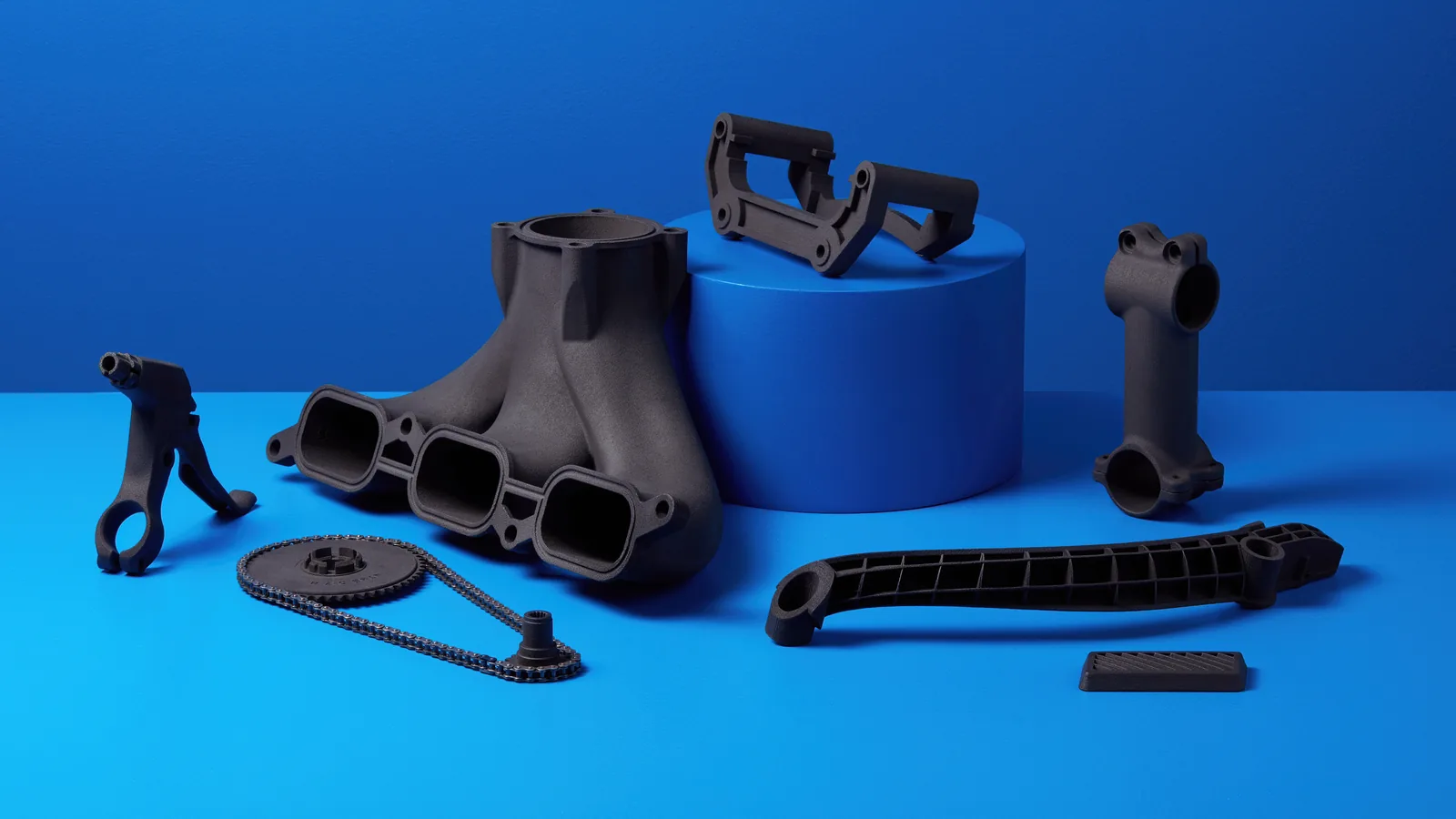
SLS 3D printing for drones, UAV payloads and defense hardware: why nylon PA11 and PA-CF make field-durable parts, how no-support geometry cuts weight, and how we run low-volume production in-country in Kyiv — fast, repeatable, and confidential.
Selective laser sintering (SLS) suits defense and UAV parts because it builds tough, lightweight nylon components with no support structures and near-isotropic strength. PA11 absorbs impact and vibration; PA-CF (Nylon 11 CF) adds stiffness and heat resistance. The result: field-durable drone frames, housings and sensor mounts, iterated and produced fast inside Ukraine.
We run SLS in our own shop in Kyiv and have printed end-use parts since 2015 (12,000+ orders). This page is the engineering case for SLS in defense and UAV work — not a sales pitch for a printer. Where another process is the honest answer, we say so.
Why SLS nylon fits drone and defense parts
A part that flies, or that a soldier carries, lives or dies on three things: mass, toughness, and whether you can get more of them quickly. SLS lines up well against all three.
- No support structures. The unsintered powder bed holds the part, so you can print thin-walled housings, internal channels, integrated clips, lattices and captive assemblies in a single build — geometry that FDM cannot make without supports scarring internal surfaces. That means lighter parts with fewer fasteners and fewer joints to fail.
- Near-isotropic strength. SLS PA12 runs ~48–50 MPa tensile with ~11% elongation, and strength is close to equal in every direction. There is no weak Z layer-adhesion plane the way there is on FDM (where Z bonding is only ~50–70% of the in-plane value), so a vibrating arm or a mount under shock load behaves predictably.
- Tough, the right kind of tough. PA11 is more ductile than PA12 and shrugs off repeated impact and flexing — useful for landing gear, battery retainers, snap-fits and living hinges that must survive a hard set-down. PA-CF (Nylon 11 CF) trades some of that ductility for ~69 MPa tensile, high stiffness and heat resistance, for frame spars and brackets that must not flex.
- Lightweight by default. Sintered nylon is roughly the density of water; with hollowing and lattice infill — both free to print in SLS — you remove grams without a tooling change. On a UAV, grams are endurance.
- Fast, low-volume iteration. No molds, no jigs to cut first. A revised mount can be in your hand in days, and the same file scales to a small batch when the design freezes. For field-driven design changes, that turnaround is the whole point.
Which SLS material for which part?
Material choice is the first real decision. These are the powders we run and where each one earns its place. PA-CF in particular has its own deeper write-up — see our PA-CF (Nylon 11 CF) page.
| Material | Tensile | Character | Where it wins on a UAV / defense part |
|---|---|---|---|
| PA12 (Nylon 12) | ~48–50 MPa | Balanced, well-characterised, matte | General housings, enclosures, brackets, jigs and fixtures — the default |
| PA11 (Nylon 11) | ~48 MPa, higher elongation | Tougher, more ductile, impact-resistant | Landing gear, battery trays, snap-fits, living hinges, anything taking repeated shock |
| PA-CF (Nylon 11 CF) | ~69 MPa | Stiff, heat-resistant, carbon-filled | Frame spars, motor arms, stiff structural brackets, payload arms that must not deflect |
| TPU 90A | Flexible (Shore 90A) | Rubber-like elastomer | Vibration dampers, gaskets, gimbal mounts, protective bumpers, cable grommets |
Values are typical for industrial SLS nylons; final properties depend on geometry, orientation and post-processing. We confirm against the specific powder lot we run.
A practical rule: if the part flexes or takes hits, lean PA11; if it must stay rigid and hold its shape under load or heat, lean PA-CF; if it just needs to be a solid, dimensionally honest enclosure, PA12 is the workhorse. One caveat we are honest about — carbon-filled powder is abrasive and stiffer, so PA-CF parts are less forgiving of impact than PA11. Match the material to the failure mode, not to the spec sheet’s biggest number.
What does SLS print for UAV and defense?
The parts that come through our shop for this kind of work cluster into a few families:
- Airframe and structural: drone frames and frame sections, motor arms, arm-to-body junctions, internal ribs and stiffeners — consolidated into fewer printed pieces.
- Housings and enclosures: avionics and flight-controller boxes, battery enclosures, antenna and radio housings, sealed compartments with printed-in cable routing.
- Payload, sensor and optics mounts: camera and gimbal brackets, EO/IR and sensor cradles, payload release mechanisms, adapter plates between airframe and payload.
- Ground-support and tooling: assembly jigs, drill and alignment fixtures, transport cradles, test rigs, field-repair adapters — the unglamorous parts that keep a program moving.
Because SLS prints assemblies in place, a multi-part bracket-plus-clip can often become one component. Fewer parts means fewer fasteners, less mass, and one less thing to vibrate loose in flight.
Is SLS durable enough for the field?
For the role nylon is asked to play, yes — within honest limits. Sintered nylon is dimensionally stable, does not absorb water the way cast nylon can, and tolerates fuels, oils and most solvents. The matte surface hides handling marks, and parts can be dyed dark for a low-visibility finish. PA11 in particular takes repeated impact without cracking, which is exactly what a hand-launched or crash-prone airframe needs.
Where we will tell you to look elsewhere: SLS nylon is a thermoplastic, not metal. For sustained high temperature near an engine exhaust, for primary load paths that genuinely need aluminium or titanium, or for ballistic protection, polymer is the wrong tool — and we will say so rather than sell a print. Within its envelope, though, it routinely outlasts machined or FDM equivalents on impact and fatigue. For the broader engineering case beyond defense, see our main SLS 3D printing overview.
How fast can you produce parts in-country?
This is the part that matters most for Ukrainian programs, and it is where local production beats an overseas supply chain outright. There is no customs queue, no multi-week freight, no border risk on a part you need this week. A typical cycle looks like this:
- Iteration: a revised design can go from STL/STEP to a printed part in a few days, so a field change feeds straight back into the next version.
- Low-volume runs: SLS packs many parts into one nitrogen-purged build with no per-part tooling, so tens to low hundreds of a part are economical without a mold.
- Throughput at scale: benchtop SLS (Fuse 1+ 30W class, 165×165×300 mm) covers prototyping and small batches; industrial SLS (Fuse X1 class, 330×330×565 mm, 120 W fiber laser) reaches on the order of ~9,693 parts/week — roughly 3× legacy SLS at about half the part cost — when a design moves to volume.
In practice that means you can prototype, validate and produce a UAV part run without the design or the hardware ever leaving the country.
What about confidentiality?
Defense work carries obligations a consumer print job does not. We treat files and designs accordingly: parts are produced in our own facility on our own machines — not farmed out — and we work under NDA on request. Sensitive geometry stays in-house, and we keep no requirement to publish, showcase or reference your parts. If your program needs specific handling or documentation terms, raise them up front and we will work to them.
SLS vs FDM for defense parts — which is right?
Both have a place, and the honest answer depends on the part. FDM is cheaper and prints very large, single, simple shapes — fine for a one-off cradle or an oversized non-structural shroud. But FDM is anisotropic (that weak Z plane), needs supports that scar geometry, and struggles with complex or enclosed forms.
| Factor | SLS nylon | FDM |
|---|---|---|
| Strength direction | Near-isotropic | Anisotropic (Z ~50–70% of XY) |
| Supports | None — powder supports the part | Required; leave marks, limit internal geometry |
| Complex / enclosed geometry | Excellent — lattices, captive assemblies in one build | Limited |
| Best role | Functional, field-durable, small-to-mid batch | Cheap, large, simple, one-off / early iteration |
Rule of thumb: prototype the form on FDM if you only need to check fit, but move to SLS the moment the part has to fly, take load, or ship as more than one. For fine cosmetic detail or casting masters, resin/SLA is the better fit — a different page, a different job.
Bottom line: how to choose
If you need a lightweight, impact-tolerant UAV or defense part in low volume, fast, and made inside Ukraine, SLS nylon is usually the right call: PA11 for parts that take hits, PA-CF for parts that must stay stiff, PA12 for everything in between. Use FDM only for large simple one-offs, and reach for metal when the load or heat genuinely demands it. The decision is the part’s failure mode — start there, and the process picks itself.
We run these machines in our Kyiv shop and are glad to look at a specific part with you — material, orientation, weight target and timeline — and print a test piece before you commit to a run. Files are handled confidentially, and production stays in-country.
Frequently asked questions
Which SLS nylon is best for drone and UAV parts?
Is SLS 3D-printed nylon durable enough for field use in defense?
Can you produce UAV parts in Ukraine confidentially and at speed?
Send your STL/STEP — quote within one hour
Official Formlabs distributor in Ukraine, production facility in Kyiv, international shipping on request.