
3D Scanning & Reverse Engineering in Ukraine
3D scanning captures a physical object as a precise digital mesh, and reverse engineering turns that mesh into an editable CAD model (STEP/IGES) you can modify, manufacture, or inspect. We run metrology-grade scanners in our Kyiv shop — Creality RaptorX, Sermoon S1 and RangeVision Pro — and scan parts from 5 mm jewelry at ±0.018 mm up to 10 m objects, on-site anywhere in Ukraine.
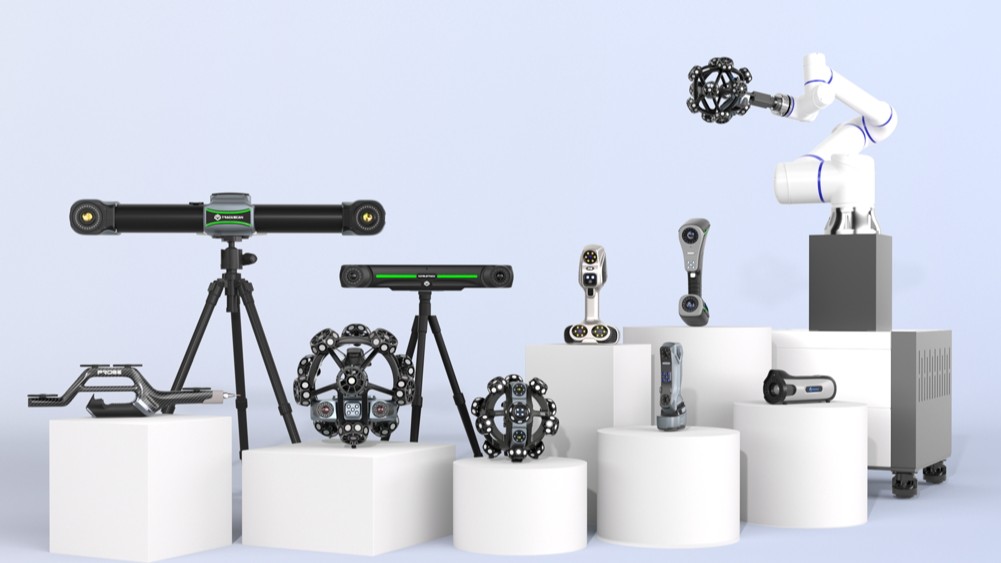
We have done this since 2015 across 12,000+ orders: an engineer captures the geometry, we clean the mesh, and you get back either a watertight STL/OBJ for printing or a fully parametric STEP/IGES model for engineering. Below is exactly what we scan, the equipment we use for each job, how the workflow runs, and how we scope a price — written plainly, with real numbers.
What can we 3D scan?
Almost anything with a surface a structured-light or laser scanner can see — from a wedding ring to a car body. The constraints that actually matter are size, surface (shiny, dark, or transparent surfaces need matting spray), and the accuracy you need downstream. Typical jobs we run:
- Engineering parts for reverse engineering — housings, brackets, manifolds, legacy spares with no drawings. Output is a clean STEP/IGES CAD model you can edit or re-manufacture.
- Automotive — body panels, intakes, custom and tuning parts, full vehicles. Scanned on-site at the workshop or our parking when the part can’t travel.
- Jewelry & small detailed objects — rings, pendants, coins, signets from 5 mm. Micro-scanning down to ±0.01 mm for faithful reproduction or resizing.
- Sculpture, art & cultural artifacts — statues, antiques, museum pieces digitized for archiving, restoration, or rescaled replicas.
- Medical & anatomical — orthopaedic models, custom braces/splints, anatomical references (we capture geometry; clinical use stays with your specialist).
- Architecture & large objects — façades, interiors, monuments up to roughly 10 m, using photogrammetry and long-range scanning.
| Object type | Typical size | Accuracy we target | Usual deliverable |
|---|---|---|---|
| Jewelry / micro parts | 5–50 mm | ±0.01–0.05 mm | STL / OBJ for print or casting |
| Engineering parts | 10 mm – 1 m | ±0.03–0.1 mm | Parametric STEP / IGES CAD |
| Automotive bodies / parts | 0.1–5 m | ±0.1 mm | Mesh + surfaced CAD |
| Sculpture / art / artifacts | 50 mm – 3 m | ±0.1 mm | High-res textured mesh (OBJ/PLY) |
| Architecture / large objects | up to ~10 m | ±0.5–2 mm | Mesh / point cloud |
What is reverse engineering, and how is it different from scanning?
Scanning gives you a mesh — millions of triangles describing the surface as-measured. That mesh is great for visual reproduction, 1:1 copies, or printing, but it is not editable engineering geometry: there are no parametric holes, flat faces, or radii you can change. Reverse engineering is the next step — our engineer rebuilds the part in CAD on top of the scan, recovering real features (planes, cylinders, fillets, threads) so you get a clean, dimensioned STEP/IGES model.
A simple rule for scoping your job:
- Need a copy, a print, or a visual model? A cleaned watertight mesh (STL/OBJ) is enough — cheaper and faster.
- Need to modify the part, mate it to other components, or document it for production? You need full reverse engineering to parametric CAD.
- Need to check a manufactured part against its drawing? That’s scan-to-CAD inspection — we overlay the scan on your nominal model and report deviation as a colour map.
What equipment do we use?
No single scanner is right for every job. Detail, part size, surface, and required accuracy decide the tool — that’s the whole point of running a fleet rather than one device. We pick the scanner to fit your part, not the other way around.
| Scanner | 3D accuracy | Best for |
|---|---|---|
| Creality RaptorX | up to 0.02 mm | Wireless on-site capture of vehicles & large objects, reverse engineering |
| Creality Sermoon S1 | up to 0.02 mm | Small detailed parts, deep holes, quality control |
| RangeVision Pro | up to 0.018 mm | High-precision stationary scanning of fixed parts |
| Photogrammetry | ±0.5–2 mm | Architecture and very large objects up to ~10 m |
A practical note from the shop: shiny, dark, or transparent surfaces scatter the projected light and scan poorly raw. We mat them with a thin, removable spray (a few microns) before capture — it adds a step but is the difference between usable data and noise.
How does the workflow run?
Every project moves through the same four stages. Where it stops depends on what you ordered — a print job ends at the mesh; an engineering job continues to CAD and QC.
- Scan — we capture the object with the scanner matched to its size and detail. On-site or in our lab. Anything from 20 minutes for a small part to a full day for a vehicle or building.
- Mesh — raw scans are aligned, merged, cleaned, hole-filled and decimated into a watertight, manifold mesh (STL/OBJ/PLY). For many copy-and-print jobs, this is the final deliverable.
- CAD / QC — for reverse engineering, our engineer rebuilds the part as parametric CAD (STEP/IGES) with real features and dimensions. For inspection jobs, we run scan-to-CAD deviation analysis and issue a colour-map report.
- Print — optional, and a real advantage of getting it all under one roof: we go straight from the model to a physical part on our own SLS or SLA/resin machines, so the geometry never leaves our pipeline.
Do you scan on-site, and where?
Yes. When a part can’t come to us — a mounted engine, a car body, a monument, factory equipment that can’t stop production — our engineer comes to you with portable, battery-capable scanners (the wireless Creality RaptorX is built for exactly this). We cover Kyiv and the region routinely, and travel to other parts of Ukraine for larger projects. On-site work means no shipping risk, no downtime moving heavy assets, and we scan the object in its real installed state.
How is pricing scoped?
We don’t quote 3D scanning by a flat per-hour rate, because two jobs of the same size can differ tenfold in effort. We price each job against four factors, and we tell you which scanner and timeline we’d use before you commit:
- Object size & complexity — a single bracket vs. a full car body is a different capture and processing load.
- Required accuracy — ±0.01 mm jewelry work needs a different scanner, more passes, and more cleanup than a ±0.5 mm architectural mesh.
- Deliverable — a cleaned mesh is the cheapest exit; full reverse engineering to parametric CAD is the most engineering-intensive and usually the largest line item.
- Location — in-lab is the baseline; on-site adds a call-out, scaled by distance from Kyiv.
The fastest way to a firm number: send us a photo of the object, its rough dimensions, the accuracy you need, and the goal (print, CAD, or dimensional check). We come back with the scanner choice, deliverable format, and timeline — usually within the hour.
Bottom line: how to choose
If you only need a faithful copy or a printable model, ask for a cleaned mesh — it’s faster and cheaper. If you need to edit the part, fit it to an assembly, or hand it to manufacturing, pay for reverse engineering to STEP/IGES; a mesh will frustrate you later. For tight-tolerance metal or engineering parts, accuracy is set by the scanner, so tell us the tolerance up front and we’ll bring the Sermoon S1 or RangeVision Pro rather than a general-purpose unit. And if the object can’t move, on-site is normal — that’s a routine job for us, not an exception.
We run these scanners in our own Kyiv shop and feed the results straight into our printing lines, so the digital model and the physical part stay in one accountable pipeline. If you have an object to digitize or a legacy part to reverse engineer, anywhere in Ukraine, send us the details and we’ll scope it honestly.
Frequently asked questions
What is the difference between 3D scanning and reverse engineering?
How accurate is your 3D scanning?
Can you scan large objects or come to our location in Ukraine?
Send your STL/STEP — quote within one hour
Official Formlabs distributor in Ukraine, production facility in Kyiv, international shipping on request.